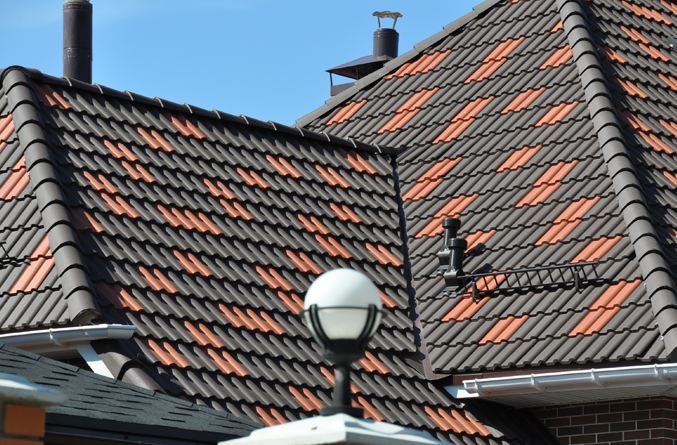
Types of the roof of a wooden house
What to choose: sheet material or artificial roofing materials? Consider 6 factors and your log house will become a strong and durable fortress!
It is important to choose the right roof for a wooden house. The roof performs several important functions: it protects the premises from the negative effects of natural phenomena (rain, snow, wind), provides sound insulation, helps retain heat inside the home, participates in the organization of natural climate control. In addition, the roof acts as a decorative element.
How to choose the type of roof for a wooden house?
The choice of the type of roof and the main material depends on:
- Total load on the structure. Climatic conditions should be analyzed (total amount of precipitation, snow and wind strength). And the roof itself should not put much pressure on the rafters.
- Operational capabilities. The roof must be reliable and durable. And for a house made of timber, the fire-fighting properties of the material are also important.
- If the house has an unusual shape (round, convex rooms), then not all materials are suitable for cladding.
- Residential VS Household. If durability is important for the first option, then economy is important for the latter.
- Pricing. The price formation is influenced by the cost of the material and the costs of its installation.
- Aesthetic component. The roof should visually match the entire structure and emphasize the advantages of a wooden house.
Sheet materials for roofing a house made of timber
The advantage of this material is its economy and ease of installation, as the material is made in sheets of different lengths and widths. The disadvantage is that when facing a house with an unusual geometric shape, a lot of waste remains after work.
Metal tile
Metal tile is a sheet material that is made of galvanized metal, adding a double-sided polymer coating. The pattern on the finished material completely repeats the relief of natural tiles.
It is used for residential and commercial premises. In addition, metal tiles can be laid on top of the old coating. Such material will last 15-17 years.
Among the advantages of this type of roofing material is ease of installation, a wide range of colors, availability, and excellent fire protection properties. But there is still a drawback - it is poor noise insulation, so this option is not suitable for a bustling city.
A similar material is corrugated board. But in addition to poor noise insulation, it has a poor color palette.
Asbestos-cement slate
This material is made from cement, but asbestos fibers are also added, a processed mineral from the class of silicates. It is also actively used, as the service life is 20-30 years.
Unlike metal tiles, asbestos-cement slate provides good noise insulation, prevents the occurrence of fire, and has a fairly attractive price. However, some European countries have banned the use of this material because they consider it dangerous for health. Asbestos belongs to the class of carcinogens. In addition, slate is very fragile and heavy.
Ondulin
Ondulin is produced from cellulose, impregnated with bitumen (a mineral complex). The front side always has an additional polymer coating.
This material is usually used for the construction of commercial premises. Such a roof will serve for about 20 years. It is rarely chosen, as the color of the coating may change over time. Among the advantages are the lightness of the material, ease of installation, good protection against wind and rain.
Folded roof
It is the most difficult to install, because the parts are attached not with nails, but by bending the edges of the sheets. Among the disadvantages are low sound insulation, high thermal conductivity (not suitable for sunny regions) and high electrical conductivity. Such material will last for about 20 years.
Artificial roofing materials
These materials are most often used for facing buildings of an unusual shape, because the minimum amount of waste remains after them.
Ceramic tiles
This type of tile is made from clay that is fired. Such a material can last up to 150 years (probably you have seen torn buildings on which the roof tiles remained intact).
Very often, this material is chosen specifically for wooden houses, because the tiles have an incredible natural look, which allows you to stylize the house in the style of antiquity. In addition, it absorbs noise well, does not conduct heat, does not burn and is not exposed to the influence of atmospheric phenomena. Among the disadvantages, it is worth highlighting the heaviness of the material and the high price.
Cement-sand tiles
It is not made from clay, but from a special concrete solution. The only advantage over ceramic tiles is a slightly lower price. Otherwise, the materials are similar.
Slate tiles
Since this material is made from environmentally friendly slate (a natural rock), it is chosen for premium construction. The material has the ability to withstand severe temperature changes, breathes perfectly and helps regulate the natural climate in a log house.
Results
So, if we single out a few main points, we can come to the following conclusions:
- Any material is suitable for the design of a pitched roof. Here, the personal preferences of the customer should be taken into account;
- The most expensive material, without a doubt, can be recognized as ceramic tiles.
- If you need to save money , for example, during the construction of a garage or other commercial building, then choose ondulin or corrugated board.
- If a residential building should be faced, metal tiles can be used as a budget option.
- Ceramic tiles and slate roofing will last the longest .
- The easiest installation of all artificial materials.
- A slate roof is considered an environmentally safe option.